
Dorothy Fratt: Explorations of Color: Dorothy Fratt
Washington, D.C
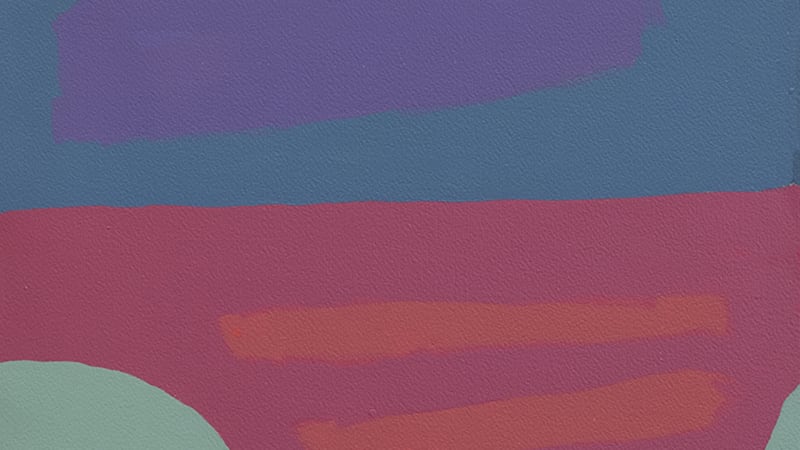
PFA is pleased to present Dorothy Fratt: Explorations of Color, an exhibition focused on works on paper mounted on canvas produced by the artist throughout her career. Featuring bold color relationships, spatial complexity, and an unwavering commitment to personal invention, these works reveal Fratt employing color as an expressive tool to create and explore ever-new color phenomena—treating color as independent from representation while drawing from her surroundings to forge her own visual lexicon on her own terms.
The exhibition will be on view at PFA's Washington, D.C. location, 1932 9th Street NW (enter from 9½ Street), from January 10 through February 28, 2026. An opening reception will be held on Friday, January 10, from 5:00 to 7:00 PM.
Across her prolific career spanning more than six decades, Dorothy Fratt consistently displayed an intuitive gift for color. Though her work bears recognizable affinity with both the Washington Color School and the arid intensity of the Arizona desert, where she spent the majority of her career, she remains an exceptional figure within the canon of postwar abstraction. Highly educated in art theory and history, Fratt developed her own distinctive aesthetic sensibility independent of external influences and commercial trends. In rendering the desert landscape in abstract visual terms, she was steadfastly committed to an exploration of the region’s striking quality of light and resulting color palette. This sensitivity to subtle variations in light and color allowed her to achieve a stunning emotive range in her own work, earning her posthumous critical recognition for her masterful contributions to color field painting.
Dorothy Fratt: Explorations of Color showcases the artist’s works on paper mounted on canvas, a body of work highlighting the breadth of her experimental rigor on an intimate scale. Spanning five decades, the works on view capture her ongoing pursuit of a visceral aesthetic language grounded in lucid, elemental color. Color is both the structural and emotional core of her compositions, taking precedence over line and form. Despite eschewing rigid forms, her approach to creation was not guided by impulse but rather thoughtful intention. Seeking to elicit sensation in lieu of defined figures or narratives, she mixed and selected each hue with exacting precision, applying each mark with purpose. Through color, she communicated experiences simultaneously intrinsic and atmospheric, transcending verbal or written explanation.
The exhibition traces the maturation of her artistic approach, highlighting the development and continuity of compositional strategies she employed throughout her career. There is a brash, gestural quality to the earliest small-scale mixed-media works, created in the mid 1960s. Working within tight confines, her forms are centrally concentrated, leaning expressionistic in their rough volatility. Yet, in 1973’s Quiet Estuary, she makes a definitive shift away from Aristotelian perspective towards her preference for “peripheral vision.” Sparse forms float at the work’s edges, resulting in a weightless spatial expanse befitting of the work’s title. This subversive approach to composition is a throughline across her oeuvre, heightened by her unique application of color. In seeking to enhance the interaction between painting and its surrounding environment, she chose to juxtapose shades nearly identical to the painting’s foundational color field. In doing so, she renders perception mutable, dependent upon the particular atmospheric conditions in which a work is viewed.
Together, the works in Explorations of Color are an expression of Fratt’s commitment to the dissolution of perceptual boundaries between the self and the world. Despite her professed proclivity for the periphery, sustained engagement with her work reveals the gravity of her creative philosophy. For Fratt, color is not only a way of seeing, but a vehicle for total immersion.
Dorothy Fratt (American, 1923—2017) received numerous scholarships to study at D.C. area art schools, including Mount Vernon College, the Corcoran School of Art, and the Phillips Memorial Gallery Art School (now the Phillips Collection). Despite working in Washington, D.C., at the time in which the Washington Color School was rapidly gaining momentum, she ultimately moved to Phoenix, Arizona, developing her style independently. Fratt has exhibited throughout the United States, her first solo show being at the Washington City Library in 1946. Since then, she has been featured in numerous solo and group exhibitions, with a major mid-career retrospective, Dorothy Fratt: 1970-1980, displayed at the Scottsdale Center for the Arts (1980). She has additionally been showcased at the Corcoran Gallery of Art in Washington, D.C.; the California Palace of the Legion Honor in San Francisco, CA; Yares Gallery in AZ, NM, NY; the Palm Springs Art Museum in Palm Springs, CA; and the Phoenix Art Museum in Phoenix, AZ. A major retrospective of her work was exhibited at the Scottsdale Museum of Art in 2024. Since 2022, PFA has worked in collaboration with the artist’s estate. Her work was subsequently featured in the 2022 solo exhibition, Dorothy Fratt: Paint the Town Red at PFA-Kensington.
The artist’s work is held in the permanent collections of numerous private and public institutions, including the New Mexico Museum of Art, Santa Fe, NM; Phoenix Art Museum, Phoenix, AZ; Museum of Northern Arizona, Flagstaff, AZ; Tucson Museum of Art, Tucson, AZ; Scottsdale Museum of Contemporary Art, Scottsdale, AZ; Hilliard Art Museum, Lafayette, LA; Palm Springs Art Museum, Palm Springs, CA; Corcoran Gallery, Washington, D.C.; Städtische Galerie, Paderborn, Germany; the Columbus Museum, Columbus, GA; and Museum Art Plus, Donaueschigen, Germany. In 2023, a monograph, Dorothy Fratt: Works, was published by Radius Books and the Scottsdale Museum of Contemporary Art in conjunction with the museum’s 2024 retrospective, Dorothy Fratt: Color Mirage.
